


Edward Mitchell Bannister
by Madison Johnstone
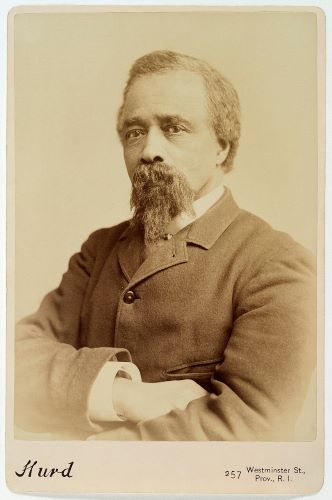
This Black History Month, we encourage you to reflect on the remarkable legacy of Edward Mitchell Bannister, the St. Andrews-born artist who became the first Black person and Canadian ever to win a national art award in the United States. While he spent most of his unprecedented career living between Boston and Providence, it was during Bannister’s formative years on the St. Croix that he first dreamed of becoming an artist.
Bannister’s life offers an enlightening view of Black history in North America. His father, Edward Sr., was a Barbados native who likely migrated to St. Andrews as a crewman on a British ship. His mother’s lineage in St. Andrews traces back to the Loyalist landing and to Africa before that. Bannister’s maternal grandmother, Violet “Black Violet” Alexander, arrived in St. Andrews as the enslaved domestic labourer of prominent loyalist Harris Hatch. According to Frances Wren, Violet recalled the day, as a young girl in Africa, when the slave ships came.
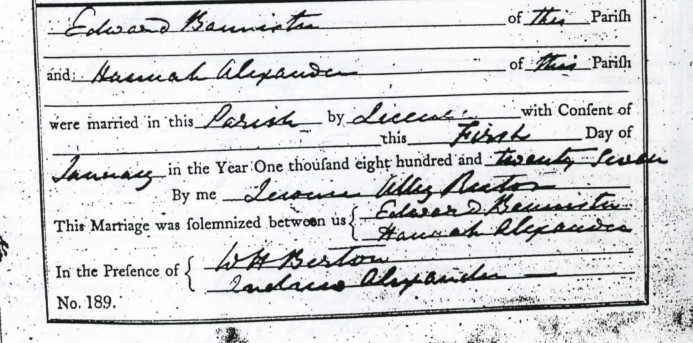
Edward Sr. married Violet’s daughter Hannah in St. Andrews on January 1st, 1827. Their first son, Edward Mitchell, was born almost two years later on November 2nd, 1828. This normalcy was short-lived when Edward Sr. died in 1832, leaving Hannah single with two sons under five. She remarried in 1840, possibly placing the family in Saint John for some time. In any event, when she passed away four years later, Bannister and his younger brother moved back to St. Andrews to live with Violet and the Hatches.
At six years old, Bannister’s world underwent radical change when the British Empire abolished slavery in 1834. Despite emancipation, opportunities were limited for people of colour in colonial New Brunswick. Bannister endured creatively. When not attending the Grammar School in St. Andrews or labouring on the Hatch farm, he honed his innate artistic talents copying Hatch family portraits and Bible engravings on barn doors. He left St. Andrews when he turned 18, taking to the sea like Edward Sr. and many Maritimers since.
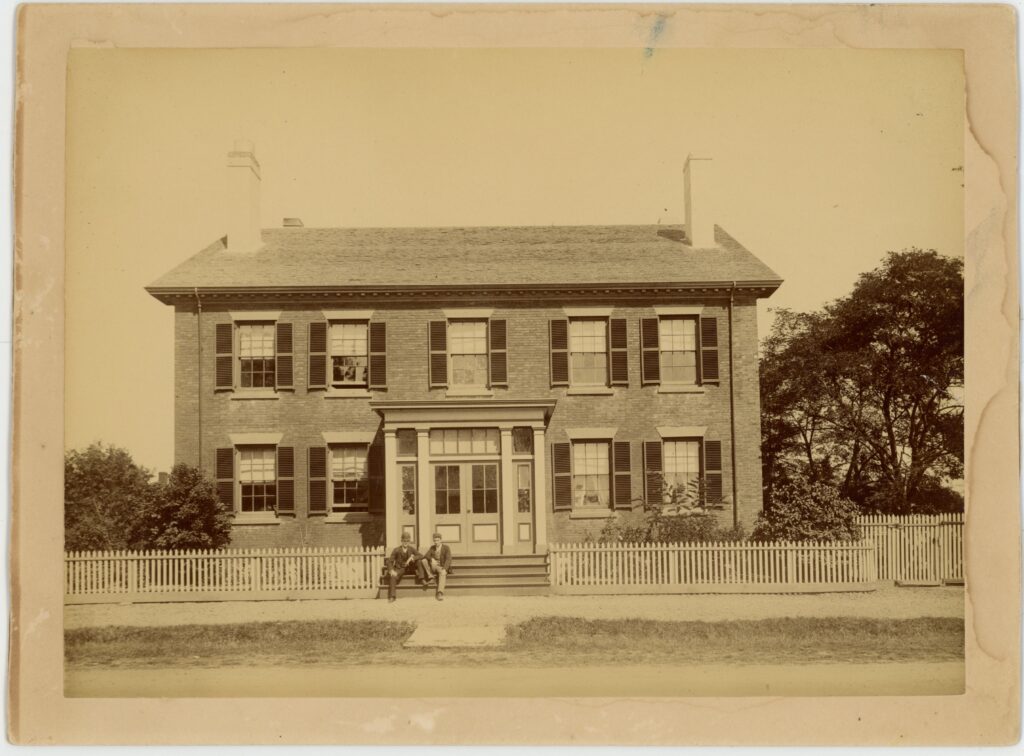
By 1850, Bannister was working as a barber in Boston to supplement his moderate income from painting sales. He seized every opportunity to paint, reportedly dashing to his easel between appointments. His ability to paint professionally was restricted by the racial segregation of art schools. Bannister lamented this lost potential, saying, “All that I would do, I cannot.” In 1853 he met Christiana Carteaux, a formidable businesswoman, abolitionist, and hairdresser of Black and Indigenous descent who at times financed his painting. They married three years later and took up residence with Lewis and Harriet Bell Hayden at 66 Southac Street, a known stop on the Underground Railroad.
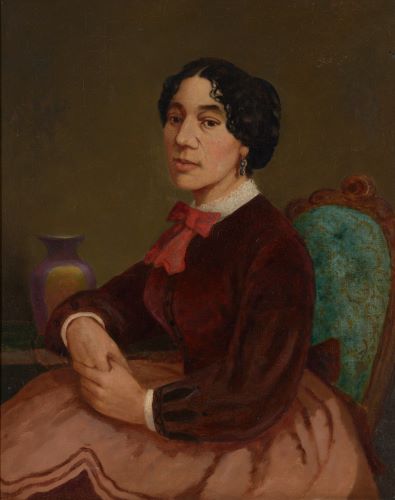
Bannister left Boston briefly in 1862 to study solar print photography in New York. Here, the prominent American painter Francis Carpenter saw his work and urged him to pursue painting full-time. When he returned to Boston the following year, Bannister enrolled at the Lowell Institute, where he studied figure drawing for two years.
Bannister witnessed the abolition of slavery for a second time when the United States ratified the Thirteenth Amendment in 1865. However bigotry persisted, and two years later, an article in the New York Herald referred to Bannister when claiming that Black people were incapable of creating art. The remark is said to have reignited Bannister’s drive to succeed, and less than a decade later, his painting “Under the Oaks” won First Prize at the 1876 Centennial Exhibition in Philadelphia.
Just one generation removed from enslavement, Bannister achieved groundbreaking success in a field that systematically excluded Black people. With little formal training he produced masterful paintings, counting among his benefactors noteworthy contemporaries such as American Civil War physician John V. DeGrasse and American inventor George H. Corliss. His professional contributions also include co-founding the Providence Art Club in 1880 and serving as a member of the Rhode Island School of Design Association from 1893-1895. In the wake of the Centennial award, Bannister enjoyed a favourable national reputation that allowed him to comfortably live out his dream of being a painter until his death in 1901.
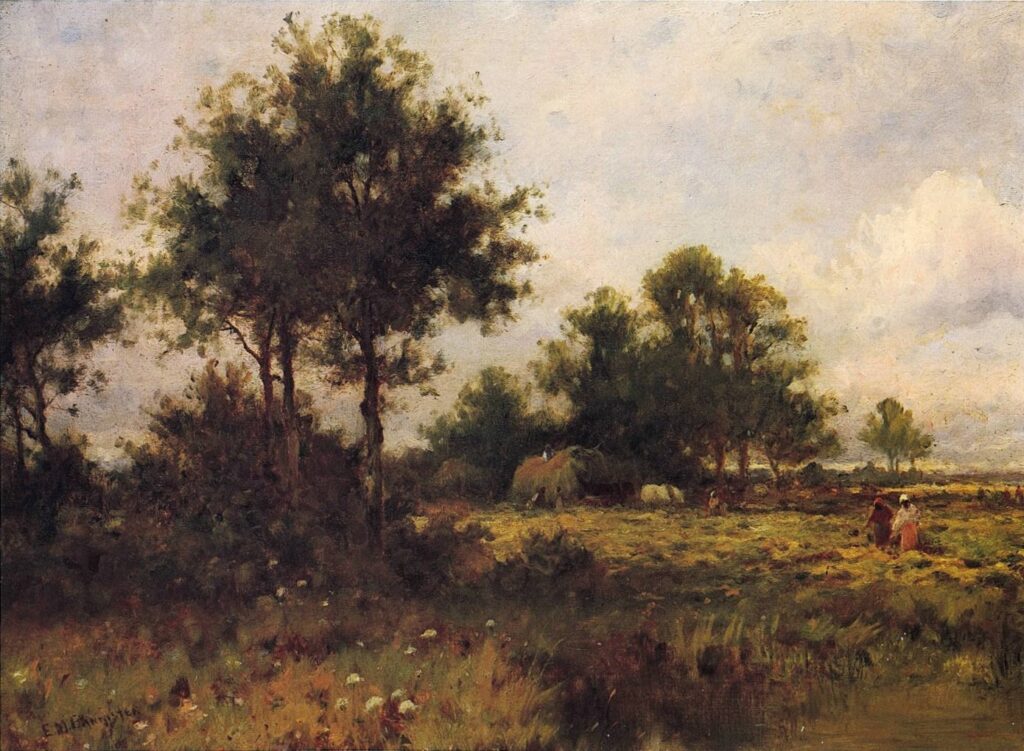
Canadian recognition of Bannister’s legacy was negligible until the early 2000s. In 2006, the Art Gallery of Nova Scotia acquired Bannister’s “River Scene” (1885). Since then, attention to Bannister has increased. In 2023, he was mentioned in an episode of the CBC docuseries “Black Life: Untold Stories”; two years later, his work was included in the “Hidden Blackness” exhibition at Owens Art Gallery in Sackville, which explored the underappreciated works of Black artists from the Maritimes.
CCA regrettably has little archival material on Bannister. We do have on microfilm a copy of Edward Sr. and Hannah’s marriage record. In the fonds “MC0143: Collection about Edward Mitchell Bannister” two biographies can be found: a photocopy of “Bannister the Idealist,” originally published in 1914 by Bannister’s friend, George W. Whitaker, and a sample from a biography by Arnold B. Ajello. We also have the art book “Edward Mitchell Bannister” and John N. Grant’s article “Edward Mitchell Bannister: The New Brunswick Years” available for reference in our Research Room.
At each turn of Bannister’s story, new perceptions of this transformative period in Canadian history are gleaned. A deeper appreciation of his legacy, this month and every month, can only be a benefit to us all.

Madison Johnstone currently works at the Charlotte County Archives as an Archives Digitization Project Intern. She graduated from Ireland’s University College Dublin in 2023 with a Master of Library and Information Studies.